
Are you pregnant? Congratulations!
From the moment you know you are pregnant you are welkom to register with our midwifery practice. We schedule a first appointment with an ultrasound around six or seven weeks.
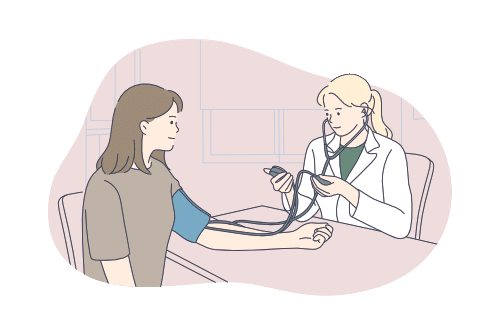
At every appointment we check your blood pressure and the heart rate and growth of the baby. We also regularly make an ultrasound. You can always contact us with all your questions or physical discomforts that are sometimes part of pregnancy. We guide you and your partner step by step in preparation for giving birth and parenthood.

If you are under care of the gynecologist in the hospital during your pregnancy, you are more than welcome to register with us for the care after your delivery, during the maternity week. Click here to sign up.
How does a pregnancy usually progress?
You may already be looking forward to holding your baby. But before that happens, you and your partner will first experience another special period: pregnancy. Don’t forget to enjoy this as much as possible and take a picture of your growing, pregnant belly regularly.
As midwives, we divide a pregnancy into three parts; the first, second and third trimester.

The first trimester
In this phase, fertilization takes place, the embryo implants itself and the placenta is formed.
Many pregnant women experience complaints such as fatigue and nausea. This is caused by the rapid hormonal changes in your body.
In these weeks you will visit your midwife for the first time, you will have the first ultrasound and your due date will be determined.

The second trimester
In this stage, various organs develop and start to function. Your baby starts hearing sounds and learns to recognize your voice.
Many women find this trimester the most enjoyable period of the pregnancy. Ailments such as nausea and fatigue have often decreased and you can finally feel your baby moving! Your belly starts to show and you gain about half a kilogram per week.
New discomforts such as ligament pain can present themselves. That is normal during pregnancy.
In this period you will visit us approximately every 4 weeks. If you want, we can find out the gender of the baby during an ultrasound.

The third trimester
In this last phase of pregnancy, the baby is mostly maturing and growing. Although a baby is ready to face the outside world after 37 weeks of pregnancy, most babies make you wait until at least the 40th week.
Your belly can become uncomfortably big and sometimes feel hard. Varicose veins, hemorrhoids and fluid retention can also occur.
In the last few weeks you visit us for check-ups more and more regularly. We monitor whether the baby is growing well and we take the time to talk about the approaching birth. We help you decide for example where you would like to give birth.
Additional tests regarding your baby’s health
In addition to the regular checkups and ultrasounds at your midwifery practice, it is possible to choose to do some extra tests that can provide more information about the health of your unborn baby. These tests, the NIPT, the 13-weeks ultrasound and the 20-weeks ultrasound, are all optional.
The tests are briefly explained on this page. We will tell you more about this during one of your check-ups. If you wish, you can also read everything about these tests on the RIVM website .
The non-invasive prenatal test (NIPT).
The NIPT is a blood test. Your blood contains a small amount of DNA from the placenta. A lab uses this to investigate whether there are indications for Down, Edwards or Patau syndrome. If there are indications that this might be the case, you are offered to do follow-up testing to get a diagnosis.
You can have the NIPT performed from 11 weeks of pregnancy.
The 13-week ultrasound (ETSEO)
The 13-week ultrasound, or the first trimester structural ultrasound scan, is comparable to the 20-week ultrasound, but earlier in the pregnancy.
The purpose of this ultrasound is to investigate at an early stage whether your unborn child may have major physical abnormalities. If there are indications that this might be the case, a specialized follow-up ultrasound is offered to get more certainty.
.
The 20-week ultrasound (TTSEO)
At the 20-week ultrasound, or the second trimester structural ultrasound examination, a specialized sonographer checks whether your baby has physical abnormalities, such as a heart defect. The sonographer will also assess whether the baby is growing well and whether the amount of amniotic fluid is normal.
The 20-week ultrasound is a reliable method to detect the possible presence of serious congenital abnormalities.
.
The last week
The birth is imminent
In the last period of your pregnancy, your body begins to prepare for the birth. You can notice this preparation in different ways, for example Braxton Hicks-contractions’. When you have these in your belly, your uterus contracts for a while, and then relaxes again. Hard bellies occur irregularly. They can last long or short and are usually not painful. From 37 weeks on, your baby is ‘finished’ and the delivery can begin. Do you feel that your labor has started while you are not yet 37 weeks pregnant? Always call your midwife.

Questions about pregnancy?
Please don’t hesitate to send us a WhatsApp message. We are happy to answer your questions about being pregnant!